Journey to the Mountains
A Story from Northern Laos
The sunset over the sea at my Thai home was so breathtaking that I simply had to share it. It painted the sky in soft gold and rose, as if bidding me farewell before a journey I had long awaited. The next day, I set off toward Laos — to the homeland of my beloved Ked, hidden among the misty mountains of the north.
The Long Road Home
Before I ever reached the village, the journey itself became an adventure. I travelled from my quiet coastal town to Bangkok, then onward to Vientiane, before taking a short one-hour flight to the tiny airstrip of Xam Nuan. From there, a “green bus” carried me into town — and there, finally, Ked was waiting for me with a smile that made every kilometre worthwhile.
After a shared meal and some essential shopping, we continued by a small car for another four hours, climbing ever deeper into the mountains. At times, the road was nothing more than a rough ledge carved into the mountainside, scarred by the monsoon rains. Yet somehow, we made it. Ked’s mother had come to welcome us too — she sat patiently on the open truck bed, under a tarpaulin with our gifts, for the entire ride, her presence both protective and deeply touching.
The return trip was far more demanding. We travelled overland, and I must admit: next time, I would gladly fly both ways. It took more than thirty hours to descend from the mountains. The first 500 kilometres were battered dirt roads; only the final hundred offered the luxury of asphalt. To imagine the road network, picture a funnel cake dipped in warm milk chocolate — twisting, sticky, unpredictable.
We slept, dozed, and shifted endlessly on the bus’s narrow wooden benches, pressed close to one another in a constant search for a more comfortable position. It was far from romantic — and yet, unforgettable. The exhaustion, the closeness, the small moments of shared smiles and quiet words made the journey feel like more than just travel. It was a test of patience and care — and one we passed together.
Cucumbers, Rice, and Togetherness
I’ve always loved cucumbers, melons, and gourds. But on this journey to Ked’s childhood home, they took on a new meaning. In these remote regions, food is precious. When there is something to eat, people gather to share it — a ritual of community and care.
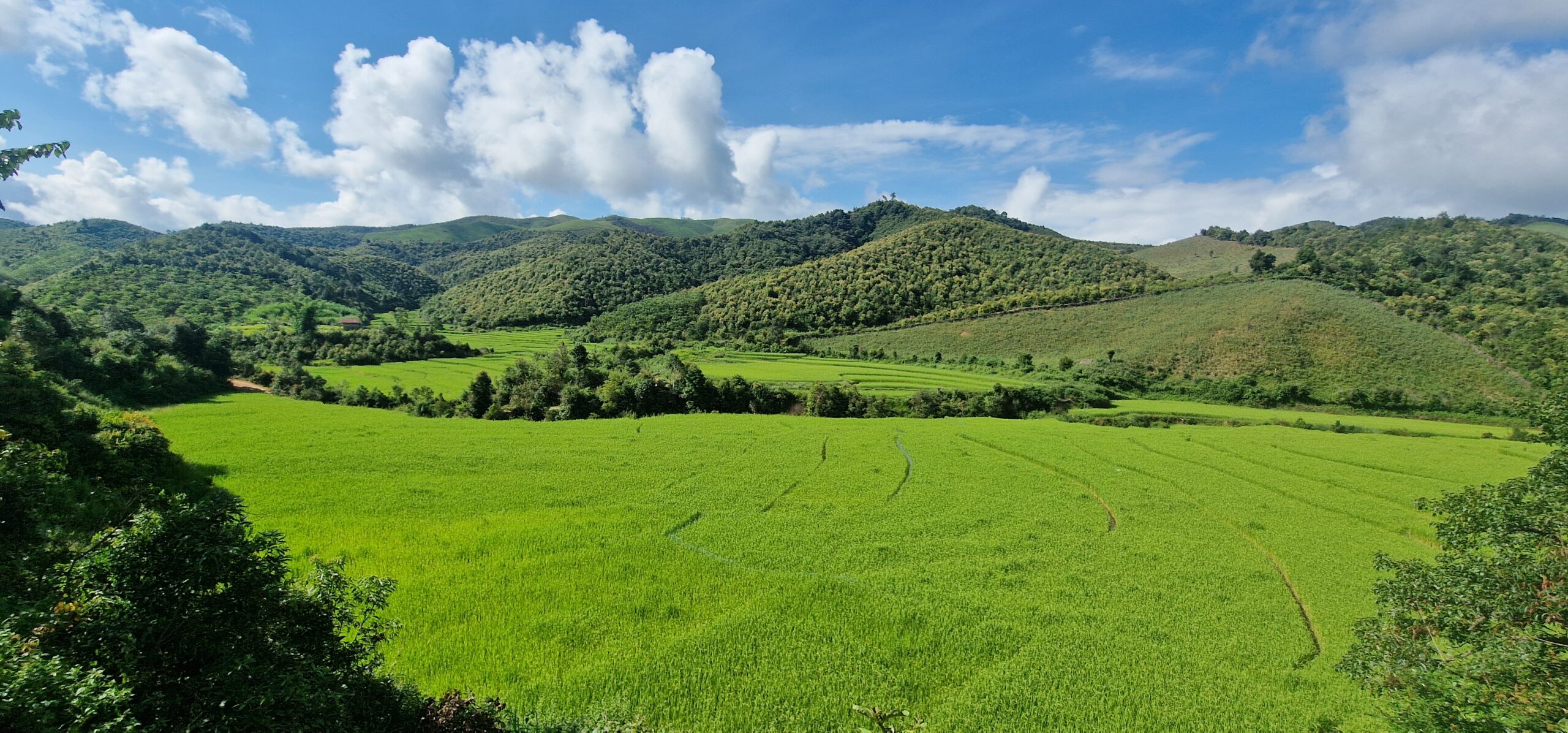
I was welcomed with open arms. At first, I was seated before the grandmother for a silent inspection. As the days passed, I was introduced to the whole village. One day, Ked, the children, and I climbed two kilometres uphill along narrow mountain paths to reach the rice fields. The six-year-old darted ahead, impatient with my slow pace, yet never once complained.
At the top, we found a patch where seeds were sown beneath taller plants for shelter. I learned that rice is not just one thing — there is the kind that thrives in waterlogged paddies and the type that grows on dry, sloping ground. Among the plants, we discovered an abundance of cucumbers and their relatives. We filled our woven baskets to the brim, and I was even given my own “children’s basket.” Carrying them down from the mountains, the baskets could weigh up to fifty kilos. The younger children carried heavy melons on their shoulders with ease.
Back at the village, we gathered in a circle to admire the harvest. Then, almost like a ceremony, cucumbers and melons were halved or sliced. Everyone peeled them in a precise way — a gesture repeated by every hand. My attempt, of course, was “all wrong.” Each slice was left with a strip of skin to serve as a natural handle while eating. By the end of the day, we had eaten kilos of them — fresh, crisp, and deeply satisfying.
Life in the Family Home
At Ked’s parents’ home, we were given our own small corner — a space I suspect is usually theirs. The house was spotless and simple, with no furniture and nothing unnecessary. People sat on the floor or on a small raised platform. Often, as we sat there, others would join us, ready to talk and share a few cucumbers.
I didn’t understand a word, but the laughter and conversation flowed freely. After a while, we managed a few words back and forth, and then, with gentle politeness, someone would ask if I was tired and I would retreat to our quiet space.
There was no internet — or very little — but I had a book on my phone and plenty of time for naps. Ked often woke at dawn to talk with his parents. Through the wall, I could hear their bright laughter, expressive voices, and soft, loving exchanges. I couldn’t understand the words, but I didn’t need to — I could feel the warmth in them, and it made me love him even more.
Family is everything to Ked — this became even clearer in the village and later in Vientiane. A joyful group welcomed me there too; everyone was a relative — and I suppose I am one now as well. Friends from outside the family are rare. It may be a challenge for Ked in the future, as our life together is much quieter. But fortunately, we have good internet where we live, and even up on the rice terraces, there is enough signal for long calls. Vientiane is not far, and perhaps we will spend more time there too.
Around the Hearth
One of the most memorable mornings of my stay began during a simple walk, when we were called over to the home of Ked’s aunt. Inside, the family was gathered around the hearth — the heart of the house. Kitchens here are often nothing more than a small room with a three- or four-legged stand holding a pot or pan above an open flame. The smoke finds its own way out through the gaps beneath the roof.
That morning, Ked’s aunt was preparing something I had long been curious to see: she was roasting a rat over the fire. Once the fur had singed away, it was carefully scraped off and the insides removed — though nothing edible was wasted. The usable parts were set aside for later, while the rat itself was placed on a grill over the flames. Smaller mice were being smoked gently above the fire.
To honour us as guests, the family had also bought some pork from the market. Several chickens had been sacrificed for the ceremonial meal as well. Rice, of course, was the central part of the meal, accompanied by whatever protein could be found — sometimes fish, often meat, and always cucumbers.
I encountered insect-based protein only after returning home, when at a local market event I tasted grasshoppers and larvae — surprisingly edible, even pleasant. The large cockroaches, however, I left untouched… though I understand that in the right circumstances, even they can be an important source of nutrition.
A Ritual of Belonging
I now truly feel like part of the family. Ked’s mother is a loving soul — accepting and supporting her son in every way. His seven sisters are each unique characters. They said they would miss Ked — and me too.
A special ritual was arranged for us, though I suspect no one knew its precise meaning anymore. A Buddhist monk led the ceremony: offerings were given, blessings shared, symbolic bites of food eaten. At the end, white threads were tied around our wrists — one by one, each person came forward to tie theirs. Even Ked’s usually reserved father tied his. He and I shared a quiet moment one morning, studying a few words from Ked’s language textbook together.
I promised to bring Ked back within two years. Yet I know now that I would not want him to stay through the summer season again. His fragile lungs cannot handle the monsoon rains, the smoke of burning rice fields, or the polluted air of Bangkok. In Ban Phe, we have a good life — a place where we can grow stronger together.
Over the summer, Ked lost far too much weight, partly due to poor food quality and scarcity, and partly due to illness. Now, we are working to help him gain it back — and I’ve joined the mission too, with a plan to lose the same amount he gains. And somehow, that shared goal feels symbolic of our love too: balanced, supportive, growing together.
Epilogue
What began as a journey to the mountains became something deeper — a journey into love, belonging, and understanding. I left with baskets full of cucumbers and melons, yes, but also with something far more precious: a new sense of family, a deeper bond, and a promise that this place — with its laughter, its rituals, its steep winding roads and smoky kitchens — will always be part of our story.